
Order of Operations
the rule that makes nerdle tick
Why PEMDAS, BODMAS and BIDMAS all agree — even when it looks like they don’t
nerdle: March 2026
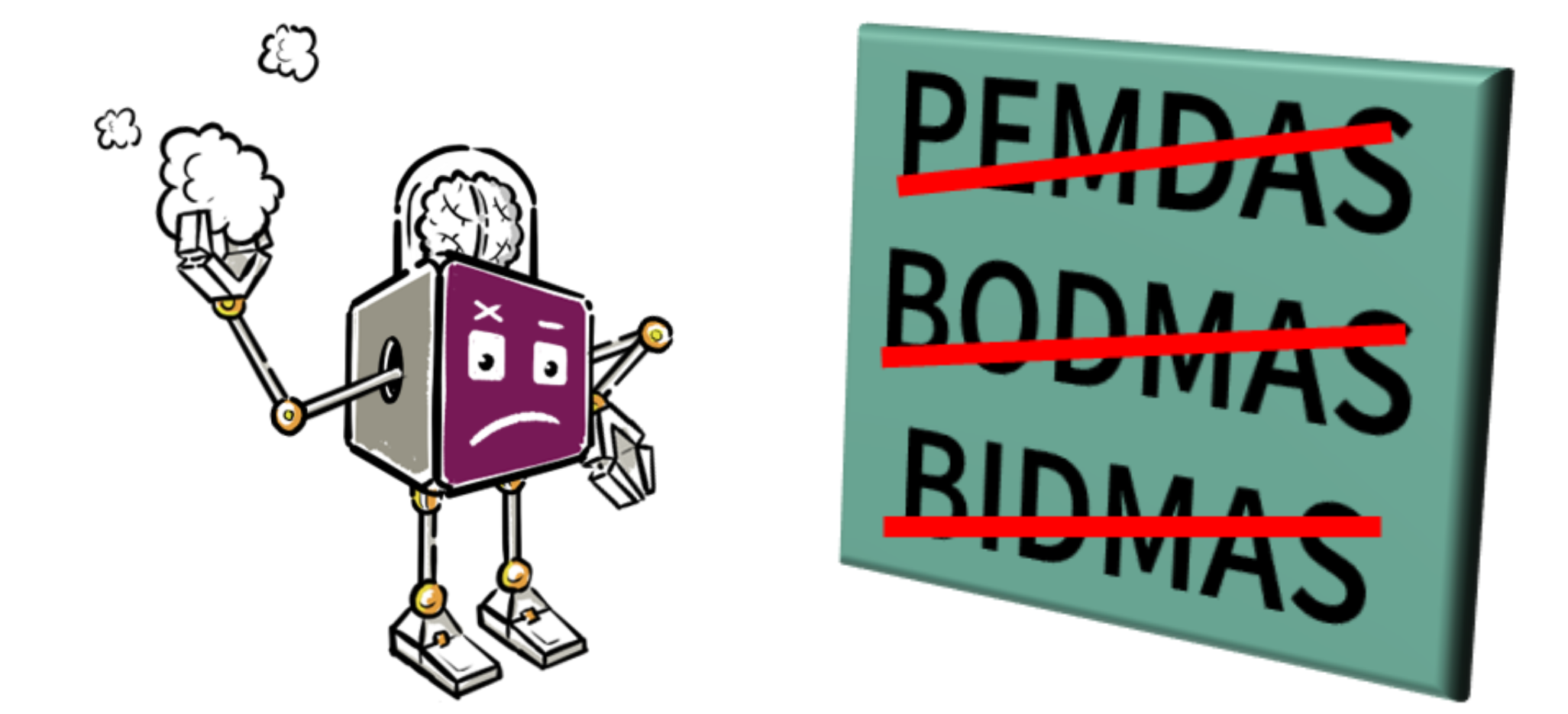
If you’ve played nerdle and been surprised when your mathematically-looking guess gets rejected with “that guess doesn’t compute”, there’s a good chance order of operations is the culprit. It’s one of the most common trip-ups for new players — and one of the most important rules to understand if you want to get better at the game. You may know it as PEMDAS, BODMAS, or BIDMAS depending on where you went to school. They all describe the same underlying rule, but they can look contradictory — and that confusion matters in nerdle.
This post explains exactly how order of operations works in nerdle, clears up a very common misconception about PEMDAS vs BODMAS, and gives you some worked examples so it all clicks into place.
What is order of operations?
In any equation with more than one mathematical operator (that’s + - * /), there has to be a rule that says which calculation you do first. Without it, the same equation could have more than one answer — and maths doesn’t allow that.
The agreed standard, used in mathematics worldwide, is:
The nerdle rule (and the maths rule)
- Brackets first — if there are any
- Then multiplication (*) and division (/)
- Then addition (+) and subtraction (-)
- When two operators have the same precedence, work left to right
Nerdle applies this rule strictly. Every valid nerdle equation — from classic through to maxi, mini, speed, and instant — must be mathematically correct using standard order of operations. If your guess doesn’t respect it, the game will reject it.
Two examples: * and / before + and -
Here is the most common case you’ll encounter in nerdle:
Example 1 — multiply before add
3
+
4
*
2
=
1
1
Do the multiplication first: 4 * 2 = 8. Then add: 3 + 8 = 11.
Not (3 + 4) * 2 = 14. The answer is 11.
Not (3 + 4) * 2 = 14. The answer is 11.
Example 2 — divide before subtract
8
-
4
/
2
=
6
Do the division first: 4 / 2 = 2. Then subtract: 8 - 2 = 6.
Not (8 - 4) / 2 = 2. The answer is 6.
Not (8 - 4) / 2 = 2. The answer is 6.
The PEMDAS vs BODMAS confusion — and why it doesn’t matter
Here is where a lot of people get tripped up. Depending on where you went to school, you were probably taught one of these mnemonics:
PEMDAS
| P | Parentheses |
| E | Exponents |
| M | Multiplication |
| D | Division |
| A | Addition |
| S | Subtraction |
M before D looks like Multiplication first — but that is not what it means.
Really: PE(MD)(AS) — the brackets show what shares the same level
BODMAS / BIDMAS
| B | Brackets |
| O / I | Orders / Indices |
| D | Division |
| M | Multiplication |
| A | Addition |
| S | Subtraction |
D before M looks like Division first — but that is not what it means either.
Really: BO(DM)(AS) — the brackets show what shares the same level
Neither mnemonic is wrong, but both are easy to misread. The key point — often glossed over in school — is that multiplication and division have exactly the same level of precedence. So do addition and subtraction. The letter order in the acronym is just a memory aid; it is not a priority ranking within each pair.
When you see both * and / in the same equation (with no brackets), you don’t do multiplication first or division first. You simply work from left to right.
The same is true of addition and subtraction: when both appear together, left to right is the rule.
Two more examples: left to right for equals-ranked operators
Example 3 — subtraction and addition: read left to right
3
-
4
+
2
=
1
Work left to right: 3 - 4 = -1, then -1 + 2 = 1.
Not 3 - (4 + 2) = -3. The answer is 1.
Not 3 - (4 + 2) = -3. The answer is 1.
Example 4 — division and multiplication: read left to right
6
/
4
*
2
=
3
Work left to right: 6 / 4 = 1.5, then 1.5 * 2 = 3.
Not 6 / (4 * 2) = 0.75. The answer is 3.
Not 6 / (4 * 2) = 0.75. The answer is 3.
Example 4 is the one that catches people most by surprise. If you were taught BODMAS and assumed division always goes before multiplication, you’d get 0.75 — which is wrong. If you were taught PEMDAS and assumed multiplication always goes before division, you’d also get 0.75 — also wrong. The correct answer is 3, because you simply work from left to right.
Watch our explainer video
If you’d prefer to see this explained visually, we made a short TikTok video on exactly this topic:
@nerdlegame Order of operations can be a bit tricky - here's how they're relevant to nerdle! #nerdle #nerdlegame #math #maths ♪ original sound - nerdlegame
Order of operations across the nerdleverse
The same rules apply whether you’re playing classic nerdle (8 characters), mini nerdle (6 characters), speed nerdle, or any of the other nerdleverse games. Every valid equation in every game must be mathematically correct — and “mathematically correct” always means standard order of operations.
In cross nerdle, where equations cross each other like a mathematical crossword, each individual row and column must independently satisfy the same rule. So it’s worth getting comfortable with it.
A quick recap
Order of operations in nerdle — cheat sheet
- * and / are calculated before + and -
- * and / have the same precedence — use left to right when both appear
- + and - have the same precedence — use left to right when both appear
- PEMDAS and BODMAS agree on all of this — the letter order is just a memory aid, not a strict ranking
For a fuller explanation of nerdle’s rules, visit our FAQ page. You can also find free nerdle teaching resources — worksheets and classroom materials — on our resources page.
Richard (chief nerd!)